After just one week of living together with us the ponies have made an amazing change, from very wary and suspicious, impossible to catch, to very friendly furry people who trot up to the gate to meet us, accept their halters and lead ropes without a complaint, and listen patiently to my monologues: that feels so good! Carrots and endless sweetness were the keys to gaining their trust.
They are both somewhat fat and out of shape (honestly, they are not the only ones in this condition), so much work must be done, by all of us, before we hit the road. But it feels a lot less daunting now that they are so much more social and cooperative!
The endless task of building our very special kitchen box and sourcing the various pieces of equipment we still need, proceeds between walking the ponies, feeding the ponies (a thankless chore, since, despite their roundness, they are costantly convinced of being starved, so that no feed is ever - ever - enough), talking to the ponies, cuddling the ponies. First things first.
Haflingers are known as a breed of friendly, intelligent and very stubborn horses: I can confirm all of that. They are sweet, they are smart and they are mules: they have their moments of getting stuck on their feet in the middle of a path and saying "No further, thanks." Since none of us can outpull such a tank built barrel of fat, muscles and fur, only infinite patience can get them going again. TomBoy is the worse of the two in this sense. When he walks he is a steam engine with blonde hair, and none of us could really keep up with him if he were not polite enough to slow down his pace and waith for us miserable crawling bipeds. Then he will suddenly decide that it is enough and just stop in his tracks until a mixture of pleading, pulling and various tactful hints at carrots, hay and eternal damnation get him going again. Definitely an authority problem here. Something else to work upon, sigh.
Kaylee is very attached to TomBoy, always getting a bit panicky when he is out of sight for even a minute, an endearing trait, but also a bit exhasperating. I hope she soon realizes that all of us are her herd now, and she needs not be too upset if they are separated for more than a few seconds.
The cats are taking to the ponies very easily, especially Muffin, who is quite fearless and enterprising. This is very curious, since her first contact with horses, years ago, in Italy, sent her into a fit of spookiness that lasted three days. But I guess living so close to cows of every size for several months put everything into a different perspective. I hope her daredevil attitude towards the big furries doesn't get her into trouble. Luckily they are only mildly curious and quite tolerant toward her.
Tuesday, October 28, 2008

Wednesday, October 22, 2008
Socializing with the horses in a very soft way, just spending a bit of time with them in the pasture several times a day. Not working together, just talking, cuddling and offering apples and carrots.
Now that they are here and real, it is scary to think how our plan depends on the good will and cooperation of these intelligent and sensitive creatures, which is not something you can buy, or build to size, or talk yourself into: only love, and dedication, and endless patience will get us on the road together. I hope they are patient too, and forgive our inevitable mistakes.
Now that they are here and real, it is scary to think how our plan depends on the good will and cooperation of these intelligent and sensitive creatures, which is not something you can buy, or build to size, or talk yourself into: only love, and dedication, and endless patience will get us on the road together. I hope they are patient too, and forgive our inevitable mistakes.
Tuesday, October 21, 2008
The Blondies

Please meet our new mates,
Kaywinnith Lee Frye (Kaylee), with the halter,
and Thomas Summer Bombadil (Tom Boy).
(who said only racing thouroughbreds can have long names?)
Sunday, October 19, 2008
The Dutch Oven
One night over the next few years you may cross a little clearing in the woods, in some old celtic place of western Europe, on a dark night, and stumble upon a scruffy looking witch poking a wooden spoon in a black cauldron and muttering to herself. Nothing to worry about, it will just be me and my Dutch Oven.
The Dutch Oven is said, by some, to be the simbol of the Pioneers way of life. My view of it is less grand, but more practical: it is what I need to roast chickens and bake pies out there in the wild (the witch impersonation is accidental). You can also cook all sort of other things in a Dutch Oven, but the baking part is what captured my imagination.
For those of you that (like me, until a few weeks ago) have no idea what a Dutch Oven is, a brief description follows: a dutch oven is a heavy cast iron pot (aluminiums ones are also available, a sign of corrupt times) with tree stumpy legs underneath and a cover with a lip running all around it. The legs hold the pot high over a bed of coals, the lip of the cover contains a further layer of glowing embers so that whatever is in the pot is heated from both bottom and up, like in a proper oven. They come in many sizes but the basic design is always the same.
Some companies sell dutch ovens that are merely pots. Beware of these tricksters. Le Creuset is one of these: Their Dutch ovens, however colourful and attractive, are only good for the kitchen oven and would be useless in a campfire. If you are looking for the real thing look for Lodge, or Qvist or Maca. There are many other brands, but these are the ones I readily remember.
My own comes from the Dutch Oven Starting Kit, from Qvist, which include heavy gloves (huge), a cover stand (very handy) and cover lifting tool (necessary). It should also include a carrying bag, but we had not the privilege of receiving it, wether by their fault or of the dealer I know not. I guess I will sew my own.
The first trial of the oven was a success, but admittedly I only cooked a stew in it. The bread or pie trial will be the real test. I adapted very loosely a recipe from this lovely website:
http://papadutch.home.comcast.net/~papadutch/
It is really the only website you need to understand the subject of dutch ovens.
My stew:
1 kg of good fresh beef, chopped
2 large onions, cut into rings
5 chilli peppers (mine are disappointingly mild this year... if your chillies are more serious two may be enough)
1 cup of Schlenkerla Rauchbier (if you cannot get Rauchbier where you live I am sorry for you, ans some other beer will have to do)
1/2 cup of Worcester Sauce
4 cloves of garlic, squeezed
the juice of one lemon
3 tablespoons of sugar
1 cup of water
Salt and pepper
Roll the meat chops in salt and pepper, and arrange in the bottom of the oven. Put the onion rings on top of them. Mix all other ingredients in a bowl and pour this sauce into the oven. Put to heat over glowing coals (from a campfire or barbeque), heap more embers on the cover and let to simmer for at least two hours, or until the meat is tender and the sauce thick and sticky. Serve with fresh spaetzle, or whatever plate ballast you have at hand (please notice that the Germans really use such an expression).
The Dutch Oven is said, by some, to be the simbol of the Pioneers way of life. My view of it is less grand, but more practical: it is what I need to roast chickens and bake pies out there in the wild (the witch impersonation is accidental). You can also cook all sort of other things in a Dutch Oven, but the baking part is what captured my imagination.
For those of you that (like me, until a few weeks ago) have no idea what a Dutch Oven is, a brief description follows: a dutch oven is a heavy cast iron pot (aluminiums ones are also available, a sign of corrupt times) with tree stumpy legs underneath and a cover with a lip running all around it. The legs hold the pot high over a bed of coals, the lip of the cover contains a further layer of glowing embers so that whatever is in the pot is heated from both bottom and up, like in a proper oven. They come in many sizes but the basic design is always the same.
Some companies sell dutch ovens that are merely pots. Beware of these tricksters. Le Creuset is one of these: Their Dutch ovens, however colourful and attractive, are only good for the kitchen oven and would be useless in a campfire. If you are looking for the real thing look for Lodge, or Qvist or Maca. There are many other brands, but these are the ones I readily remember.
My own comes from the Dutch Oven Starting Kit, from Qvist, which include heavy gloves (huge), a cover stand (very handy) and cover lifting tool (necessary). It should also include a carrying bag, but we had not the privilege of receiving it, wether by their fault or of the dealer I know not. I guess I will sew my own.
The first trial of the oven was a success, but admittedly I only cooked a stew in it. The bread or pie trial will be the real test. I adapted very loosely a recipe from this lovely website:
http://papadutch.home.comcast.net/~papadutch/
It is really the only website you need to understand the subject of dutch ovens.
My stew:
1 kg of good fresh beef, chopped
2 large onions, cut into rings
5 chilli peppers (mine are disappointingly mild this year... if your chillies are more serious two may be enough)
1 cup of Schlenkerla Rauchbier (if you cannot get Rauchbier where you live I am sorry for you, ans some other beer will have to do)
1/2 cup of Worcester Sauce
4 cloves of garlic, squeezed
the juice of one lemon
3 tablespoons of sugar
1 cup of water
Salt and pepper
Roll the meat chops in salt and pepper, and arrange in the bottom of the oven. Put the onion rings on top of them. Mix all other ingredients in a bowl and pour this sauce into the oven. Put to heat over glowing coals (from a campfire or barbeque), heap more embers on the cover and let to simmer for at least two hours, or until the meat is tender and the sauce thick and sticky. Serve with fresh spaetzle, or whatever plate ballast you have at hand (please notice that the Germans really use such an expression).
Thursday, October 16, 2008
The Road goes ever on and on
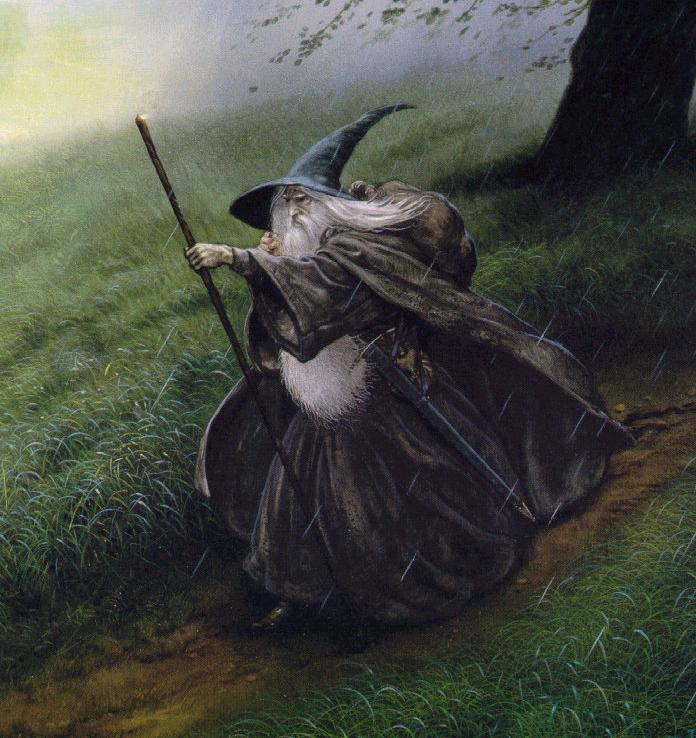 Gandalf, by John Howe
 Exchanging mails with Claire (my British Twin), about Middle Earth, trees, Ents and Rohirrims.
Will I see Tom Bombadil during my travels, just for a moment, just out of the corner of my eye?
I blame "The Lord of the Rings" for my budding wanderlust, even if it took 20 years for the book influence to become manifest.
"The Road goes ever on and on
Down from the door where it began.
Now far ahead the Road has gone,
And I must follow, if I can,
Pursuing it with eager feet,
Until it joins some larger way
Where many paths and errands meet.
And whither then? I cannot say"
Fond as I was, even as a child, of my familiar things and home (a real hobbit in the making), I was always a bit horrified of Bilbo running off "without a hat, a walking stick or any money, or anything that he usually took when he went out" not even a pocket handkerchief. And yet I always was fascinated that you could live so light that those things were not important any more, and all that mattered was the Road, running ahead, and on and on.
The Lord of the Rings (and the Hobbit with it) is so deeply a "walking" book. Horses, eagles and boats do provide an occasional burst of speed to the story, but if one thinks of the book in its whole, it looks like the hobbits are always walking (or eating, on occasions). The very slowness of their progress brings Middle Earth to life in the tiniyest details. It is not just a succession of framed landscapes, but a true winding trail, alive with flowers, pebbles, old trees, soft grass, rustling leaves... mushrooms. I think it affected forever my way to conceive travelling.
I have three different editions of the Lord of the Rings, an italian translation, the first version that I had, in five volumes (including the Hobbit and the Silmarillion, all in one box), luxuriously bound in red fabric, with gilt, embossed titles, and huge folded maps on thick parchment paper, a format that Bilbo would have thoroughly approved; a beautiful heavy tome illustrated by Alan Lee and a humble and much abused paperback which is to this day my favourite edition... perhaps because I was always able to tuck it into my rucksack for travelling. The cover is an illustration of Gandalf purposefully striding through a grassy landscape, under the rain. It was painted by John Howe. The spine of the book is faded, but Gandalf's grass is still richly, deeply green.
I aquired this paperback when I was 19 in perhaps the first holiday I ever made without my family. It was also the first time I could read Tolkien in his original language, and one of the very first books I read in english at all. It feels so much like my first very own book, in a certain sense.
Will I see Tom Bombadil during my travels, just for a moment, just out of the corner of my eye?
I blame "The Lord of the Rings" for my budding wanderlust, even if it took 20 years for the book influence to become manifest.
"The Road goes ever on and on
Down from the door where it began.
Now far ahead the Road has gone,
And I must follow, if I can,
Pursuing it with eager feet,
Until it joins some larger way
Where many paths and errands meet.
And whither then? I cannot say"
Fond as I was, even as a child, of my familiar things and home (a real hobbit in the making), I was always a bit horrified of Bilbo running off "without a hat, a walking stick or any money, or anything that he usually took when he went out" not even a pocket handkerchief. And yet I always was fascinated that you could live so light that those things were not important any more, and all that mattered was the Road, running ahead, and on and on.
The Lord of the Rings (and the Hobbit with it) is so deeply a "walking" book. Horses, eagles and boats do provide an occasional burst of speed to the story, but if one thinks of the book in its whole, it looks like the hobbits are always walking (or eating, on occasions). The very slowness of their progress brings Middle Earth to life in the tiniyest details. It is not just a succession of framed landscapes, but a true winding trail, alive with flowers, pebbles, old trees, soft grass, rustling leaves... mushrooms. I think it affected forever my way to conceive travelling.
I have three different editions of the Lord of the Rings, an italian translation, the first version that I had, in five volumes (including the Hobbit and the Silmarillion, all in one box), luxuriously bound in red fabric, with gilt, embossed titles, and huge folded maps on thick parchment paper, a format that Bilbo would have thoroughly approved; a beautiful heavy tome illustrated by Alan Lee and a humble and much abused paperback which is to this day my favourite edition... perhaps because I was always able to tuck it into my rucksack for travelling. The cover is an illustration of Gandalf purposefully striding through a grassy landscape, under the rain. It was painted by John Howe. The spine of the book is faded, but Gandalf's grass is still richly, deeply green.
I aquired this paperback when I was 19 in perhaps the first holiday I ever made without my family. It was also the first time I could read Tolkien in his original language, and one of the very first books I read in english at all. It feels so much like my first very own book, in a certain sense.
John Howe other paintings can be admired in his own home page:
Monday, October 13, 2008
Waiting for the horses to be deliverd to us, just can't wait for them to be here. They are two Haflinger ponies, a mare and gelding of 6 years. Very well behaved, very cooperative and friendly. The agreement is Eric will name the mare and I will name the gelding.They were both "family horses" before being put on the market for different reasons. They don't show any of the nevrotic symptoms of riding school horses.
In the mean time I am building the kitchen box (chuck box) for my cart. A bit of a shock passing from the 6 meters of work top of my kitchen to this tiny thing, but, funny enough, the working surface is not much smaller than it was in my old kitchen. Everything is relative.
The tent trial was fun. We had the tent in the meadow for four days and always slept outside during the trial. I love how the sleeping bag warms up the first minute you are in. The bed feels a lot colder. One night I was especially tired and Eric asked me if I was up to sleeping in the tent at all. I said "I just can't take the cold tonight, yes, let's sleep in the sleeping bags."
We never had any wind though, while the tent was up. Just typical.
In the mean time I am building the kitchen box (chuck box) for my cart. A bit of a shock passing from the 6 meters of work top of my kitchen to this tiny thing, but, funny enough, the working surface is not much smaller than it was in my old kitchen. Everything is relative.
The tent trial was fun. We had the tent in the meadow for four days and always slept outside during the trial. I love how the sleeping bag warms up the first minute you are in. The bed feels a lot colder. One night I was especially tired and Eric asked me if I was up to sleeping in the tent at all. I said "I just can't take the cold tonight, yes, let's sleep in the sleeping bags."
We never had any wind though, while the tent was up. Just typical.
Friday, October 10, 2008
Subscribe to:
Posts (Atom)
